Tuesday, November 15, 2011

A Day At Kokrobite


This weekend (October 29), my friend Sarah and I were ambitious. She invited me to go to Kokrobite as one of the other Canadians in our building was celebrating her birthday on Saturday. Everyone who has gone to Kokrobite seems to love it so I thought a day at the beach was what I needed. We left for Kaneshie Station around 5pm on a Friday. We knew traffic in Accra is bad at the best of times and I anticipated that the journey would take longer seeing as this was the busiest time of the week to travel. Kaneshie struck me as being straight out of an old market neighborhood in India. All of the buildings were old and covered in a thick layer of dust and dirt. As we approached Kaneshie, the taxi driver told us to put up the windows as “they boys here are criminals”. Theft is common in these areas and this wasn’t unexpected. This was another place (similar to Circle), where the best precaution is to keep all valuables in your bag and to wear your bag on your front. As silly as this sounds, you see locals doing it as well which tells you its probably a good idea. A nice man told us he was going to the Kokrobite tro tro station and we followed him through a sketchy poorly-lit road. The line up was long despite tro tros arriving frequently. 
After some messing around we ended up jumping on one of the big Metro buses. There were no seats but we decided we could stand for the 25km journey. Wrong. The trip took almost 4 hours (I wish I was exaggerating), and after a while your legs start to hurt. Knowing the likelihood we wouldn’t arrive in time to get dinner, I was glad I brought snacks and that we could buy food while on the bus (a huge bonus of Ghana). The road leading to Kokrobite was quite steep and very bumpy but eventually we made it to Big Milly’s Backyard. I was so exhausted from the week that I elected to go to bed early so I would be rested enough to enjoy the beach.


Kokrobite Beach
The beach was perfect and the water was warm. We had a great breakfast, bought some things from vendors at the beach and played in the water. Kokrobite beach is very different from Labadi Beach in that you go to the vendors, they don’t come and hassle you every 5 minutes. Dresses and scarves are huge there and I got a cute little African sundress for 7cedi. The usual tourist trinkets and beads are also available.  We had a wonderful lunch at Kokrobite Garden in an outdoor dining area. The pizza was truly delicious and I think it was a close tie between that pizza and Peter’s Pizza in Aburi. The service was great and the food was amazing. Well worth the money!
Some of the fishing boats on the beach


After our lunch, the tide was coming in so the waves were bigger and stronger. You can’t really go out far enough into the ocean to swim because even when you are knee deep in the water, the undertow is quite strong. We continued to enjoy the beach before our dinner. One wave caught me by surprise and I was swept under and almost lost my hat and sunglasses. 

Walking along the beach at sunset

In summary, the weekend was wonderful and Big Milly’s Backyard was a really nice place to stay. We didn’t stay for the Saturday night reggae but I still had a blast. The food was delicious and well worth the money. Kokrobite is more expensive than I was anticipating but you are paying to be right on the beach. The low cost of transportation and proximity to Accra made it well-worth the trip. For what you get at Kokrobite, the price is reasonable. 


Thursday, November 3, 2011

Ghana Driving Rules


A friend of Veronika's drove us to the Accra Mall last night and on our way we reflected on the Ghanian rules of the road. We came up with six humorous rules of the road that are not included in the Drivers Manual! We don't recommend trying this
1. Lay on your horn pretty much the entire time. Honk if you see an Obruni, honk if you see a friend, honk if the light turns green, etc etc.

2. Drive FAST. Because the traffic moves so slowly when you have room just put the pedal to the metal and go for it. Who obeys the speed limit (or who knows what the limit actually is?) anyways?

3. Don’t give way. You might lose your spot in the lineup. If you end up in the middle of the intersection after the light turns red, no big deal. Just ignore the onslaught of horns you will get. If you can see road between the front of your car and the bumper of the car in front, you’re leaving too much of a gap. Tighten up!

4. Drive in all of the lanes, don’t pick just one, that’s just boring.

5. After dark, either drive with no lights at all (you’ll wear them out), or only with your high beams on. Who drives with their regular headlights anyways? Much better to blind oncoming drivers.

6. Traffic lights are not the law, just a suggestion. If you are a motorcycle this really applies. The police won’t bat an eye in your direction if you choose to blast through an intersection on a red light. Don’t try to avoid pedestrians, they’re soft or they’ll get out of your way.

I'd like to think I'm a competent driver however I don't know if I could drive in Ghana in Accra during busy traffic times. Unreal. 

Volta Region - Another entertaining adventure that derailed (slightly)


Despite the harrowing adventure at Nzulezo last weekend, I decided to try another University of Ghana trip this weekend. My new friend Veronika suggested the Volta Region trip organized by the UG Business School. Billy even joined us as he was in Accra for the weekend.
In true Ghanian fashion, we left late. The busses were supposed to pick us up at 1am but they didn’t arrive until after 2am. We finally left campus after 3:30am. We asked our guide why we were so late and he responded that people had forgotten things and had to return to their hostels to fetch their things before we could leave. How different than field trips in Canada where the bus leaves on time whether or not you have all of your things! Sarah and I were quite frustrated with how difficult it seemed to get the correct number of people on each bus. How hard can it be?


Veronika and I posing with goats near Tafi Atome
I LOVE goats!


Unlike the trip last weekend, we were able to get some sleep on the bus which was a large coach bus with comfortable reclining seats and A/C. Our first stop was the Tofi Atome Monkey Sanctuary. We arrived quite early in the morning and our guide was very informative however he struggled to get the attention of all 200 people who went on the trip. From what I could understand, the monkeys lived in the forest long before people migrated there and at first they had a relatively symbiotic relationship. At some point, there was a conflict with the deity that lives in the forest and that is connected to the monkeys. From what I understood, the local community began to destroy the monkeys both by killing them and destroying the forest habitat where they live. The monkey population plummeted and thanks to a special Canadian who came to study the monkeys in the 1980s, the local community was able to save their dwindling monkey population. According to our guide, the local community was very receptive to the advice given by the Canadian and they established the monkey sanctuary to protect the monkeys. The monkey population is close to 300 which is an impressive increase in population in 30 years. The monkeys are Mona Monkeys and they are quite tame. Our group was quite loud so they monkeys didn’t come very close to us however we were told that if you are a small group, the monkeys will come and sit on your shoulder! Hopefully we’ll be able to go back and test this out!

Tafi Atome Monkey Sanctuary: One of the Mona Monkeys 


Our next stop after a wonderful breakfast was Mount Afadjato, the highest peak in Ghana. Good thing I wore proper running shoes because it was truly a mission to make it to the top! Ensuring that the path to the peak was accessible for people was clearly not a top priority. My pictures don’t adequately convey just how steep it actually was. Girls were wearing flats or flip flops and everyone was wearing jeans - I have no idea how they managed to make it up! I have never been so sweaty in my life. Imagine being asked to do 200 squats in a hot sauna, the climb was sort of like that. It took us well over an hour to make it to the top. I stumbled a few times on the way up and many people had to take frequent breaks because it was so physically demanding. Once at the summit, however, it was totally worth the effort. It was so beautiful to see the villages from up above and the surrounding mountains. Unfortunately after we had taken some success pictures, the rain started to pour and we had to put our cameras away. I’m so disappointed I didn’t get more photos to share. Getting back down the mountain was more difficult than the climb up. The path became a river of water and of course everything was much more slippery. Once your legs are tired and your muscles start to shake, climbing becomes very tricky. Luckily a nice young guy named NaNa helped me down the mountain, ensuring I didn’t break myself. Despite this, I did slip and hit my back on some rocks which wasn’t nice. Maintaining your balance was difficult and in some places the best way to get down was to slide down on your bum. You can imagine the state of our clothes when we got down. Luckily most people had an extra change of clothes so it was nice to get dry. 


The path was so steep climbing
Mount Afadjato, what a serious workout!


On top of Mount Afadjato - finally made it!


Our next stop at Wli Falls had to be cancelled because of the weather. There is a 45 minute walk to the base of the falls and with all the rain, it wasn’t feasible. We did get to see the town where the falls are located and snap a few pictures before the gave us a lunch of rancid chicken and rice. You know the food is no good when the locals and foreigners alike refuse to eat it! Our guides were not happy at all with the caterers.
At this point, we thought we were heading to the Club house where we were supposed to have a BBQ and a swim however once we reached the bridge at Akosombo, we realized we were heading back to Accra. The roads on the way back were interesting. All of the rain we were having resulted in some flooding of the roads and so the busses had to proceed very carefully. Passing some of the villages, you could really appreciate how much flooding can impact the people that live there. Due to poor drainage or the village being located in low ground, water was everywhere. Even some of the drains could not accommodate the quantity of water.


Our dinner stop was quite brief and the food was OK. They pulled out some speakers and many students got out and danced. Ghanians are truly far better dancers than most Canadians and it was fun to watch them dance. The music was good as well. There seems to be a few key songs that they like to play over and over again. At this point in the day, the once spotless busses were covered in garbage and smelled awful after people had been sweating all day and got soaked on the mountain. By the time we got back to campus, 22 hours after we were supposed to have left, we were beyond exhausted. Luckily our clothes survived the trip and I was able to get to bed within two hours of arriving home.
All in all, this trip was far more fun than last weekend. Despite the rain and being unable to see everything we were supposed to see, we were comfortable for the trip and we made our own fun by making jokes the whole way and trying to understand the movies and music that were being played.
Wonder what will happen next weekend.

Tema-Accra Flooding


This was one of my school submissions but I thought it was a really interesting topic so I reposted it here

The rains should have stopped in Accra in September, however we are still experiencing heavy rains at the end of October. The flooding that resulted from the heavy rain from Monday to Thursday of this week has claimed the lives of 9 people in the Tema-Accra area in addition to the destruction of homes and many businesses. 
During a trip to the Volta Region this weekend, we endured incredibly violent rains as we climbed to the top of Mount Afadjato. The rain made descending the mountain very dangerous and we could tell that the village was going to experience some flooding as the sewers couldn’t cope with the water. The remainder of the trip was sadly called off due to the weather. The long drive back to Accra was slowed because the water had flooded or washed away the road in many places. Some of the small villages we passed were flooded after only a few hours of rain. It was obvious they would have major clean-ups to do once the rain had stopped.
Accra and the surrounding areas have been pummeled with heavy rain and thunderstorms this week. One severe storm on Monday was literally on top of my building, I’ve never been woken up by such a loud storm in my life. Despite being located on top of a hill, campus has been flooded with water and the sewers, clogged with empty sachets and black plastic bags, couldn’t drain the water resulting in a wonderful smell coming from overflowing gutters. If the existing sewers were clear of debris, the flooding would not have been so severe. According to the Daily Graphic newspaper, this is a reminder that efforts to improve infrastructure and planning in Accra are greatly needed in addition to educating the public of the need for insurance to help people recover from such a disaster.
There are three issues at play here. First, the changing of the seasons. People at work have repeatedly commented that we shouldn’t be experiencing rain at all in October and that this is a prime example of the effects of climate change (I couldn’t agree more). People here seem to be able to identify changes in the rainy season as being a direct, observable result of climate change. The link between the unbelievable car emissions and climate change doesn’t seem to resonate as much. I still find it puzzling how nobody finds it as appalling as I do! I like that people are able to identify what they are experiencing as a result of climate change however they don’t propose any actions to limit it. Secondly, there is a huge lack of infrastructure in Accra. The open gutters and sewers are incapable of coping with such a large amount of water. Smell aside, overflowing gutters present a huge health problem for people including a higher risk of malaria (from standing water where mosquitos breed), to the unsanitary conditions of having waste and garbage floating around. The biggest issue is flooding, as experienced this week. The newspaper indicated that many businesses had to close in areas where the flooding was severe. The National Disaster Management Organisation (NADMO) did respond and helped people pump water from their homes however many in areas like Santa Maria spent the night on their roofs in the rain to avoid the flooding. Thirdly, the victims of the flooding are hard-pressed to find a doctor as the doctors strike has yet to be concluded here. Doctors have now been told to stop providing emergency care to force the government to meet their demands.
After seeing the pictorial and news articles in the Daily Graphic, I am reminded that although the rain inconvenienced me this week, it could have been much much worse. Hundreds of people lost their businesses, personal property, even vehicles that were swept up in the flooding. My office remained open during the flooding as Legon is not a low-lying area and other than getting quite wet on my trip to and from work, things were normal. I know people in the office were very upset by this newspaper yesterday when it was published, now I know why. Some suggestions proposed by government officials in the newspaper are to change people’s behaviour when it comes to waste disposal. All of the discarded plastic waste clogs up sewers and hinders an already overextended system from operating optimally. The other aspect, which relates to city planning which seems to be completely lacking in most parts of the city, is to prevent people from building on water courses. 

Tuesday, November 1, 2011

6 Months Left

I wrote this post on October 21st but due to Ghana internet - I haven't been able to post.


As of this week, I only have another six months left of placement. I can’t believe I’ve been here in Ghana for a month and a half. Some days it feels like time is flying by, other days it feels as though it is dragging on endlessly. In honour of having six months remaining, I have assembled a list of my six favourite things about Ghana.
Food: I was expecting a diet including a LOT of rice however I wasn’t prepared for how good the food is here! Most of the food here is high in carbs but I know I am healthier now because nothing is really made with any preservatives - everything I am eating is made fresh that day with fresh Ghanian produce. My first love when we got here was jollof rice (think regular rice cooked with tomato sauce with some vegetables thrown in and a generous portion of chili peppers!!) which I eat at least twice a week. Red red is another popular thing here - plantains fried in palm oil (yes this is very bad for you) with beans (I think?). It’s quite tasty but I try to limit myself to prevent stomach issues later on. My new love is fufu with groundnut soup! Fufu does take a bit to get used to, you’re not supposed to chew it, simply swallow it. Considering we are so used to chewing everything, my first attempt at fufu was very slow as I consciously had to remind myself not to chew. Groundnut soup is wonderful and a bit spicy and I’m sure it will become one of my favourite dishes. In Ghana you won’t be going hungry. There is lots of food that is delicious.
The morning: I love the five minutes I spend every morning just contemplating life on my balcony while watching the world go by. It’s usually less noisy in the morning than it is later in the day so I like to enjoy a bit of peace and quiet - a unique thing in Accra! 
Countryside: Accra give little indication of the beauty of Ghana. Accra is dusty, busy, and noisy. Once you leave Accra and head east towards the Volta region, the natural landscape is beautiful and lush. The tree covered mountains and the green landscape are stunning. Sometimes I really wish I could pack up and move somewhere else in Ghana. But that is what weekends are for, I really enjoy getting out of Accra.
Beautiful scenery at the top of Mount Afadjato


People I work with: I really am growing to love my co-workers, quirks and religion and all. I am amazed with how kind they are to me and how much they enjoy telling me all about Ghana and helping me to get my footing here in Ghana. They love hearing about Canada, especially about snow and the Inuit which doesn’t surprise me much. I find it very interesting to compare things like health care and school here in Ghana to what I have experienced in Canada. They have been helping me with my trip planning also and are keen to hear about what adventures I get up to on the weekends.


Music: I am starting to hear more Ghanian music and some of it is really good! Some of it is quite inappropriate and some is borderline offensive - especially the song whose chorus is “Thank God I’m not a Nigerian”. It is rather shocking that such blatant discrimination is allowed on the airwaves. I like how even the music is laid back and relaxing (not that Ghanians are in need of relaxation). It is challenging to work when Ghanian music is being played in the office because when you’re hot and listening to tropical music - all you want to do is sit on a beach somewhere. Ghanian movies are also something else. I got my first taste of Ghanian movies this week on the bus to Volta region. Boy some of them are really badly acted and very very low budget. Some of them aren’t so bad though. I do understand why people complain about how loud they play the movies - it is very difficult to sleep with a movie blaring. 
My friends: While it took a couple weeks to start making good friends - I am now thoroughly enjoying traveling with friends that I have made here in Ghana both foreign and local. Even if our trip doesn’t go well or bad things happen (Nzulezo), we always seem to manage to have a blast and make the most of it. I am going to really miss those who are leaving in December. I also appreciate that we can talk about some of the challenges we face being outsiders in a completely different culture and some of the frustrations we experience. I also enjoy learning about other people’s life experiences in their home countries. It’s pretty cool how you make friends from around the world when you are overseas.


With friends Veronika and Lisa at Nzulezo
It’s quite amazing how time flies when you’re away. It feels like I’ve just arrived but that I’ve been here my whole life. I am finally mastering simple daily tasks like feeding myself and getting around. I’m very proud of myself that my geography has improved tremendously. I have a good grasp on East Legon, Madina, Haatcho, and the University campus. Simply knowing where I am at all times makes me feel a lot more comfortable. My Twi is improving a bit. I can say the words however my accent is not correct (I seem to revert to a French accent for some reason). I can say the days of the week and tell you what day of the week it is and what tomorrow is, I can ask your name and tell you mine, and I can greet you in the morning. I have started learning how to count which I hope to master this week.

Thursday, October 20, 2011

Dude I'm Totally Married


For the record: I am not married. I have a boyfriend I love very much but we are not married. In recent weeks I have adopted this ‘party line’ to make it easier for me to deal with men who approach me when I’m out and about and it is a perfect reason why I can’t take them to Canada with me, or go for dinner with them, or give them my phone number etc etc. I’m not a liar and thus it has taken me several weeks to get better at repeating this storyline.
The amount of hassle I get greatly depends on where I am in Accra and within the country. Madina I found particularly bad for this type of thing. A two hour shopping trip resulted in many requests for me to either get them a Visa to Canada, send them a plane ticket to Canada, or simply for me to take them back to Canada with me. One man was so bold that when I told him I was taken he asked to see my ring! (that was a first)
The main road leading to Madina Market
Some shops in Madina - you can buy pretty much
anything here from food to cellphones to shoes
you name it - someone has it


Madina is a very busy place and it is a bit
disorienting. Be careful to not get hit by a car


This morning I know I was not in the greatest of moods and I was also quite late getting to work. A boy selling phone credit at Okpongolo Junction said Good morning to me and after I greeted him, he told me he loved me. I just kept walking, having a little laugh on the inside. I don’t think I had walked more than 500m before a guy about my age said “wait, come talk to me for a minute” I gave the usual song and dance that I was late for work (which I was) and that I couldn’t stay and chat. That didn’t deter him and instead of having a conversation I just came right out with “dude I’m totally married”. I repeated this twice before he got the hint and walked away. I mean, it is completely possible that he just wanted to have a friendly chat with me. This having been said, I feel like most times I do have a chat with men here, it ends with them asking me for my phone number or asking to date me or again, asking me to take them home with me.

Another morning adventure to work last week was equally amusing as a mate of a broken down tro tro on Madina Road flat out said “good morning, can I have your phone number” I of course said no to which he asked “can I give you my number? you call me?” Sometimes I really wonder if they do it just to mess with you. It’s pretty obvious you don’t belong (your skin colour might have been their first hint), and they know you will say no nine times out of ten. This does make me wonder if they get a kick out of ‘messing with the white girls’. 

On a more positive note, on one of my first solo missions to the Mall, I was having some trouble getting a tro tro home. I choose to go to the smaller platform instead of the main one because there are less people fighting to get into the cars. A boy around my age came up and asked me where I was going. He was really sweet and helped me get on the tro tro to Legon. He even paid for my fare (the equivalent of 20 cents), which he didn’t have to do. We parted ways at the roundabout on campus after he asked me (innocently enough) if I would go with him to eat fufu one evening. I told him no that I have a serious relationship back home and that Kevin wouldn’t be happy if I went for dinner with another man. Kevin found this whole encounter a bit amusing. I laughed really hard when he asked me “why did that guy pay for your tro tro?” - not a question I EVER expected to be asked!
Kevin & I Summer 2011

Sometimes though, men will just not get the hint as I discovered one afternoon I met up with some other Canadian volunteers for lunch. The guy would not leave us alone after inviting himself to sit at our table while we ate lunch. This young man couldn’t understand how he was being dishonest by saying he wanted to be friends when he wanted a whole lot more than that. At some point you have to be firm and basically say “get lost”. Being subtle or too nice (or ‘Canadian’ as my German friends say), doesn’t get you very far! I’m practicing being more firm - what an odd thing to have to practice.
It is a nice break to go places where you don’t stick out as much. I find wandering around campus is a perfect example of this. There are people from around the world who live on campus and by being a University campus, the number of non-student people who are there is pretty minimal.

One thing I was looking forward to was making local friends as a way to learn more about the culture and life here in Ghana. This is trickier than it sounds for several reasons. Firstly, women are less likely to come up to you and propose friendship (a quick survey of the foreign friends I’ve made have all said that they don’t have female Ghanian friends). Secondly, a lot of the time ‘friends’ doesn’t mean ‘friends’ the way we know it to be. Thirdly, no matter what  you do whether it’s learning the language or dressing Ghanian, you are always going to stick out to some degree. This is not to say that it’s impossible to make friends, however it does take longer than when you are making friends with foreigners. 

Don’t get me wrong, I greatly appreciate the fact that when I am going somewhere and I have the “I’m REALLY lost or confused” look on my face, someone will ask if I need help almost immediately. It’s truly wonderful and I greatly appreciate their assistance even if their directions are frequently wrong. You can make out pretty quickly what the person’s intentions are. Being friendly with people is good, just not too friendly.
As with pretty much everything in Ghana - patience is key.


A truly WILD trip to Nzulezo


In hindsight, I should have KNOWN that something wasn’t quite right when the 3am departure time came and went with no sign of the vehicle to take us to Nzulezo. In the end due to poor planning on the trip organizer’s part, I went on the trip without my friends. Visiting Nzulezo - the only stilt village in Ghana - was one of the top things on my list after the Bradt Guide highly recommended going. I was amazed how awake the city was at 4am, with tro-tros and people starting their day. After a couple of hours, we ended up in Cape Coast and our guide took us past the castle and fort and through the boat yard and market place. It was still quite early in the morning and thus the market was very quiet however, the castle was beautiful and I can’t wait to go back to Cape Coast and visit.
Road to Beyin (near Nzulezo)
Once we passed Takoradi in the Western Region, the road rapidly got worse and the bumps and holes became bigger and more frequent. The last hour of the trip was on a dirt road (I’m being generous), that was more bumps than road. Again, all of us on board were realizing that our driver was not taking necessary precautions to ensure the safety of all of us on board. Driving too quickly, making minimal effort to avoid holes and laughing when he hit bumps, this driver was not being careful enough.
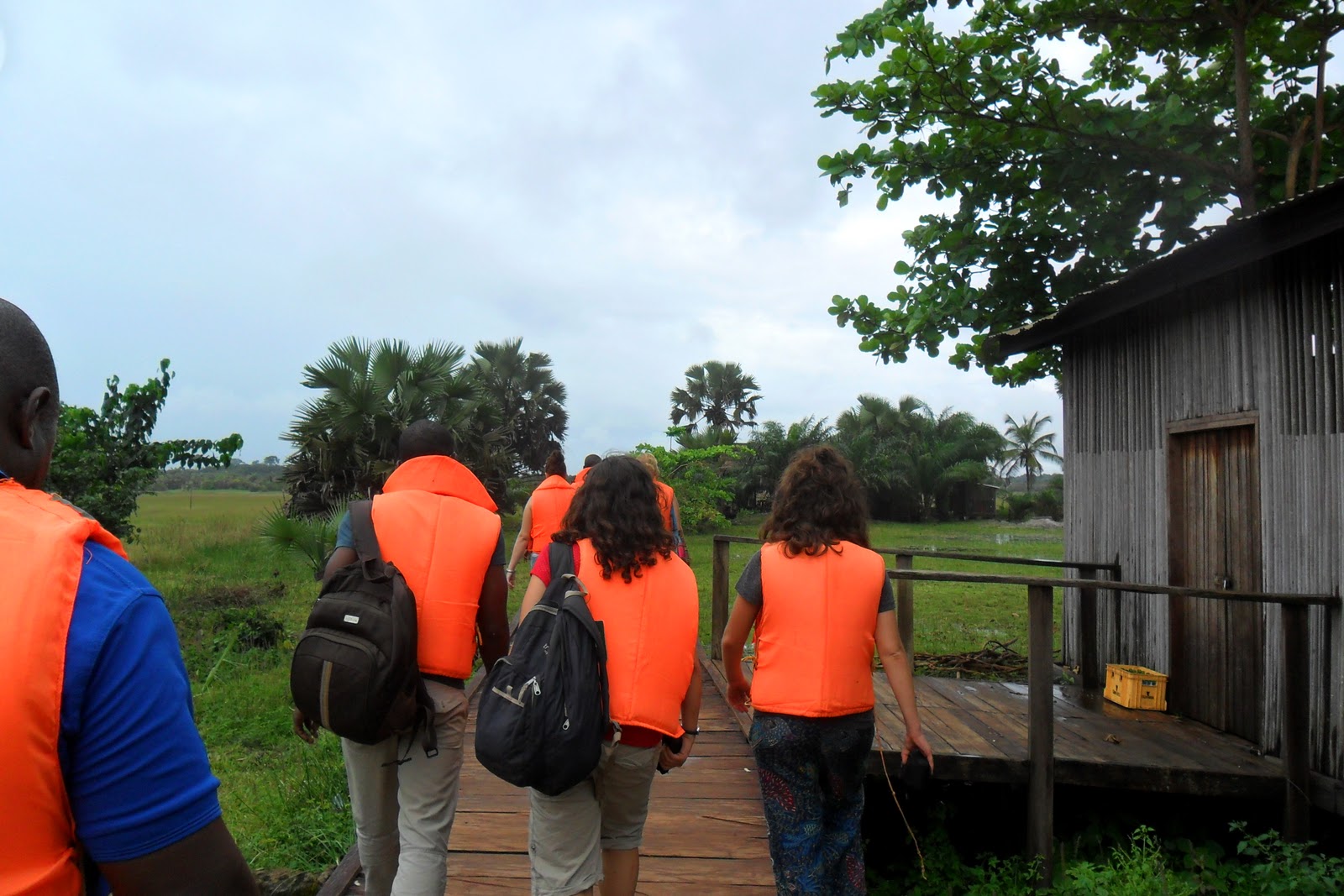
Once we arrived at the Ghana Wilderness Society building, the skies opened up and heavy rain began to fall. We were concerned that we would have come all this way to not be able to see the village. Luckily the rain let up once we finished a rather bland and cold lunch of beans and red red and we set off towards the canoes. 
Walking to the canoes

Me looking quite scared on the canoe to
the village of Nzulezo
Unlike the dugout canoes which the villagers use, our canoes were made out of wood planks. The village has an outboard motor which they attach to a canoe in case of emergency as it takes a full hour to paddle from the dock to the village. One website I found about Nzulezo says that they villagers are not allowed to use the motor but this simply isn’t true. We eventually reached the village after being rained on (again) in the canoes. In hindsight - I wish I had brought rain gear!

The loo


As you can imagine, the houses were quite small and clustered closely together. Most of them were plain wood (except for the pink house - my favorite), and simple houses of one room. I can’t imagine living there let alone having children and living there. The walkways often had holes or boards missing leaving gaps big enough for children to fall through or at least get their foot stuck. I would be terrified to let my children go out and play here! The most beautiful building in the whole village was the Pentecostal church in the rear of the village. For such a small village, they had two churches that we saw. The best part was the loo. Can you imagine having to go to the bathroom in the middle of the night and having to walk to this outhouse? One thing in particular that surprised us was that the villagers were proud to drink the ‘cleanest water’ which they drew from one side of the village while the waste water and all of their garbage was dropped into the water on the other side of the village. The chief was adamant that the water was cleaner than bottled water and that because the water was ‘swift moving’ their waste was carried far from the village. Somehow I doubt that this is the case. I’m sure that over generations people have developed immunity to whatever is in the water but I certainly wouldn’t feel comfortable drinking the same water that people use as a toilet and garbage dump. It really surprised me how much garbage there was in the water and on the walkways. Many walkways were littered with pieces of wood and other things while the water behind the village was littered with plastic and containers.


Garbage. This is the 'waste dump' side of the village
water for drinking is drawn from the other side of the village
maybe a few hundred feet apart


I enjoyed hearing the chief talk about how his people came to settle in Nzulezo which means, not surprisingly, living on water. The original inhabitants were originally from Mali and were chased from their land by Senegalese people. The originally walked to Wenchi in Brong-Ahafo region however they were told to keep moving south, eventually finding the area which is now Nzulezo. They chose this area as the water protected them from their enemies in addition to their deity who protects the village from invaders. Every year, the descendants of the people who sought refuge in Nzulezo perform a ritual sacrifice to appease the deity. It is unique how they are able to maintain their traditional beliefs while most also attend church every sunday. There was a few troubling things at Nzulezo that deserve mentioning. We were told that the village is not hooked up to electricity, however, there was music playing and people on cellphones in the village while we were there. It was frustrating that all of the children persistently asked for either money or a pen. We respected the wishes of our tour guide and did not take pictures of the locals without asking (a huge reason why most of the pictures don’t have people in them other than us), however they really hurried us along and seemed reluctant to let us take pictures. I did enjoy the trip, however I would have liked to know more about the daily lives of the people who live in the village.
View of the Ocean from
Apollonia Fort

After the visit to Nzulezo, we were taken to Fort Apollonia which was nearby. This restored fort is now a museum dedicated to the history of the tribe who live in the area - the Nzuma people. Basically the entire tribe belongs to one of seven clans all of whom play a vital role in local leadership in the area. The Fort was beautifully restored in the last couple years and I got some great pictures of the ocean in the background. I wish I had been more awake because the guide was really trying to inform us however we were all exhausted (we’d been awake for over 16 hours at this point). 
Photo from inside the fort. Front entrance
is the door in the background


The trip back to Accra was a bit hair-raising to say the least. Again, the driver ignored our requests to slow down and there was a few times I almost hit my head off the roof because he was speeding and hitting holes or speed bumps. Eventually after a really stern talking to at a bathroom break stop, he did slow down somewhat between Takoradi and Cape Coast. Between Cape Coast and Accra though, the speeding resumed. Driving here is very dangerous, especially at night where the roads are not lit the way they are in Canada. Speed only adds to the danger. I’ve never had as scary a car ride here in Ghana.


All in all, I did enjoy the trip. Had the trip been better organized and the driver been more responsible and the car actually comfortable, I think I would have come away with a better memory of the trip. The scenery was beautiful and I hope to return to the Western Region for a trip again.